
The runtime stays in the customer account
EntryLayer runs as a Snowflake Native App on Snowpark Container Services, so the application runtime is installed in the customer account.
Security and trust
EntryLayer is designed for security reviewers who need concrete answers: where the app runs, where state lives, how source reads are authorized, and what leaves the account. It is not a second warehouse or a vendor-hosted source-data store. It is an operator-facing app installed inside Snowflake.
Security facts
Before a platform team reads every architecture detail, they need quick answers about runtime, storage, source access, telemetry, and what the provider can see.
Review packet
The page below is organized around the questions a Snowflake security or platform reviewer will usually ask first. Use the links as a short evaluation path, then go deeper in the docs.
Canonical public reviewer URL for architecture, residency, source access, extraction, and billing flows.
Published response targets, intake, escalation, and notification practices.
Secure development, vulnerability management, release review, and vendor controls.
Where the app runs and where application state lives.
How caller-backed reads preserve Snowflake policy where supported.
What EntryLayer records when people edit, review, approve, or access work.
What can leave the account, and what should not be part of event payloads.
How admins inspect setup, member roles, and access diagnostics.
Runtime boundary
EntryLayer is not positioned as a disconnected data-entry SaaS that pulls source data into a provider-hosted system. The Native App deployment keeps the interface runtime, workflow state, and admin surfaces aligned to the Snowflake boundary.
Inherited access controls
EntryLayer is designed around caller-rights access for consumer-owned Snowflake sources. When a user opens source-connected records, the product should not bypass Snowflake policy with a broad shared credential.
Auditable workflow state
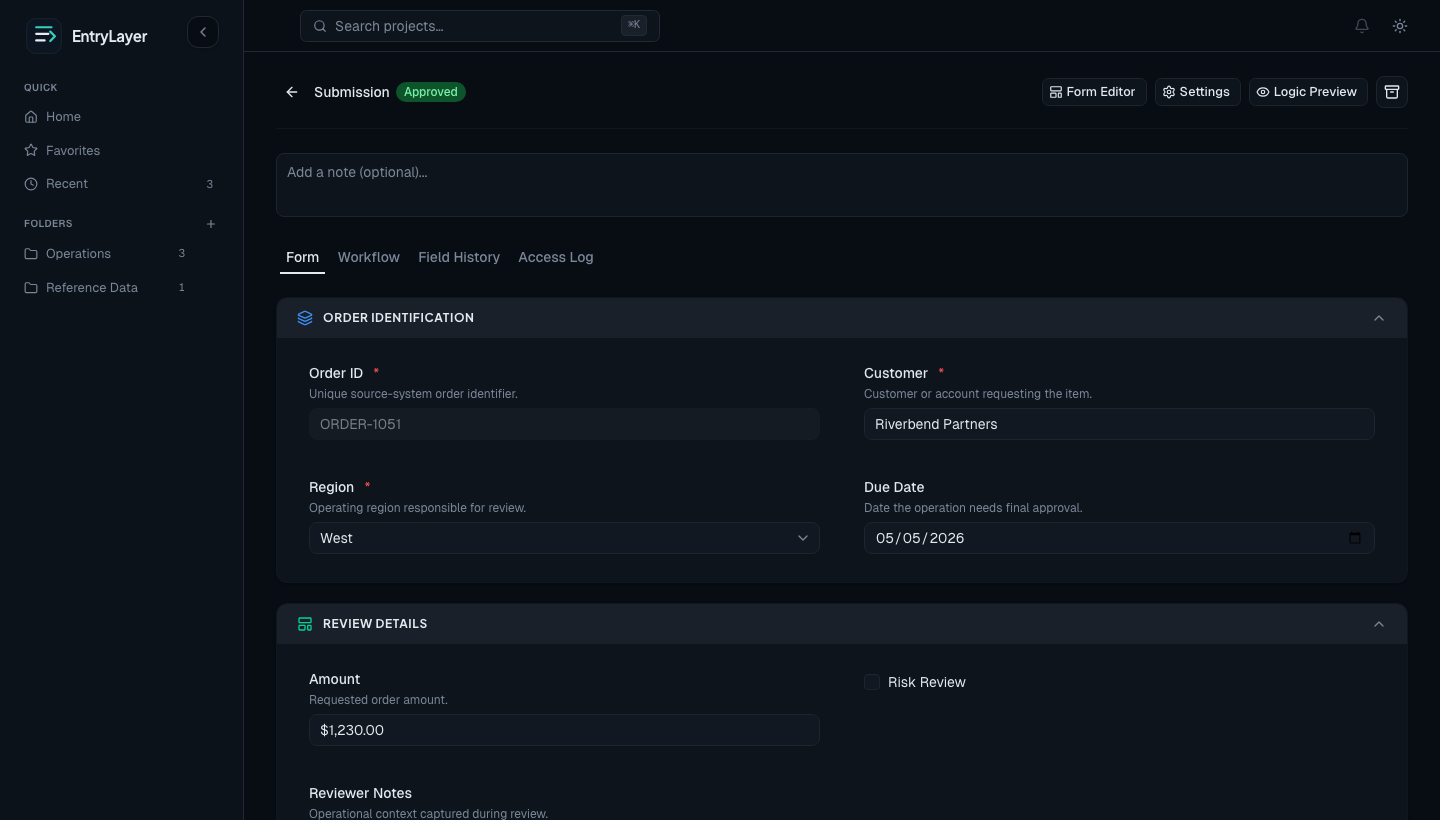
Security is not just about who can read a value. It is also about whether the team can reconstruct what happened. EntryLayer records approvals, edits, access activity, and workflow transitions so operational work can be reviewed like the rest of the platform.
What the security story actually is
The strongest part of the EntryLayer posture is that the trust model is legible. A reviewer should be able to inspect where it runs, how it reads data, what gets logged, what billing can include, and what admins can diagnose without relying on broad assurances.
EntryLayer runs as a Snowflake Native App on Snowpark Container Services, so the application runtime is installed in the customer account.
For supported consumer-owned sources, caller-backed reads keep row access, masking, and object grants with Snowflake.
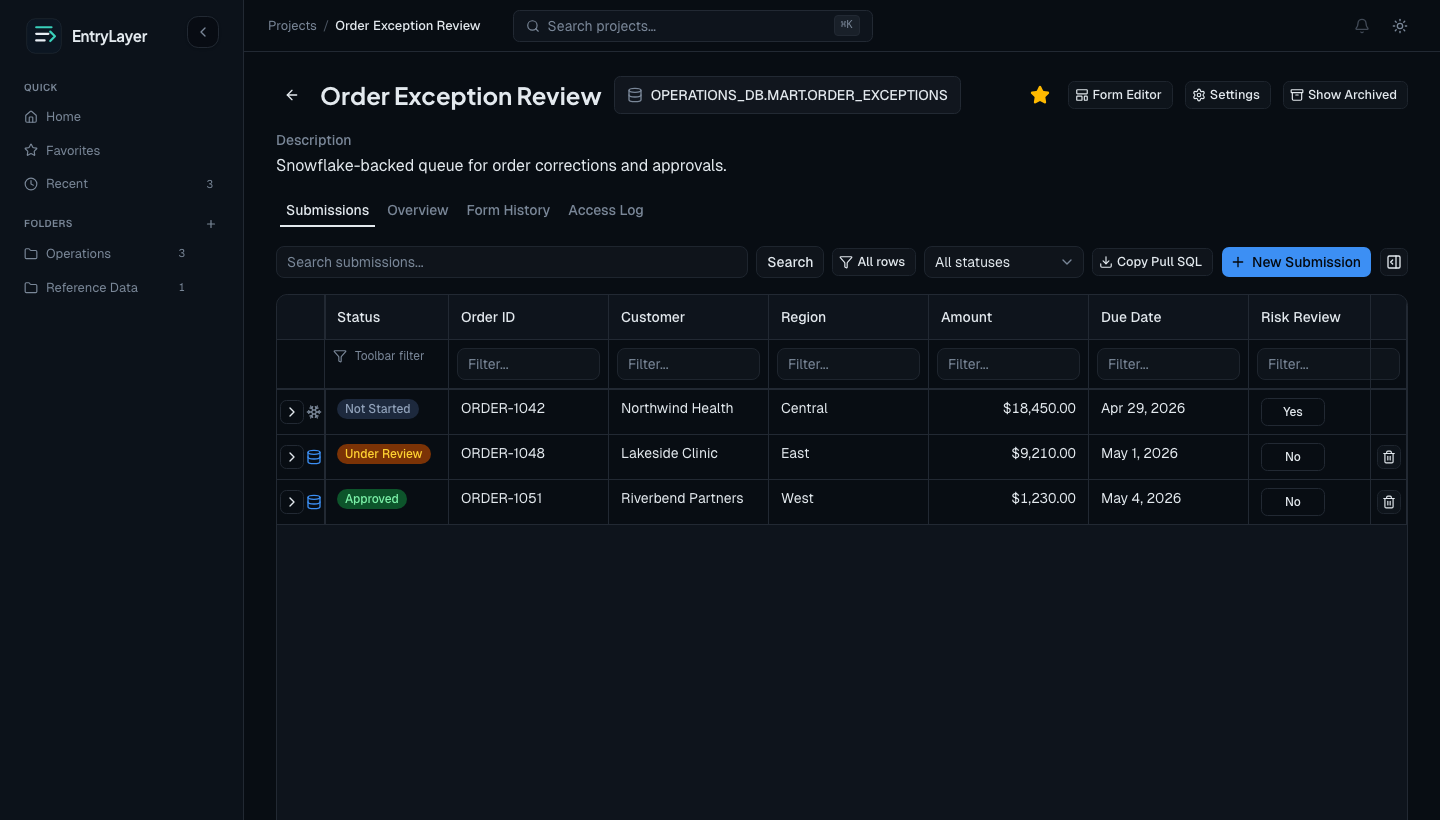
Projects, submissions, memberships, review actions, and access activity live in Snowflake Hybrid Tables.
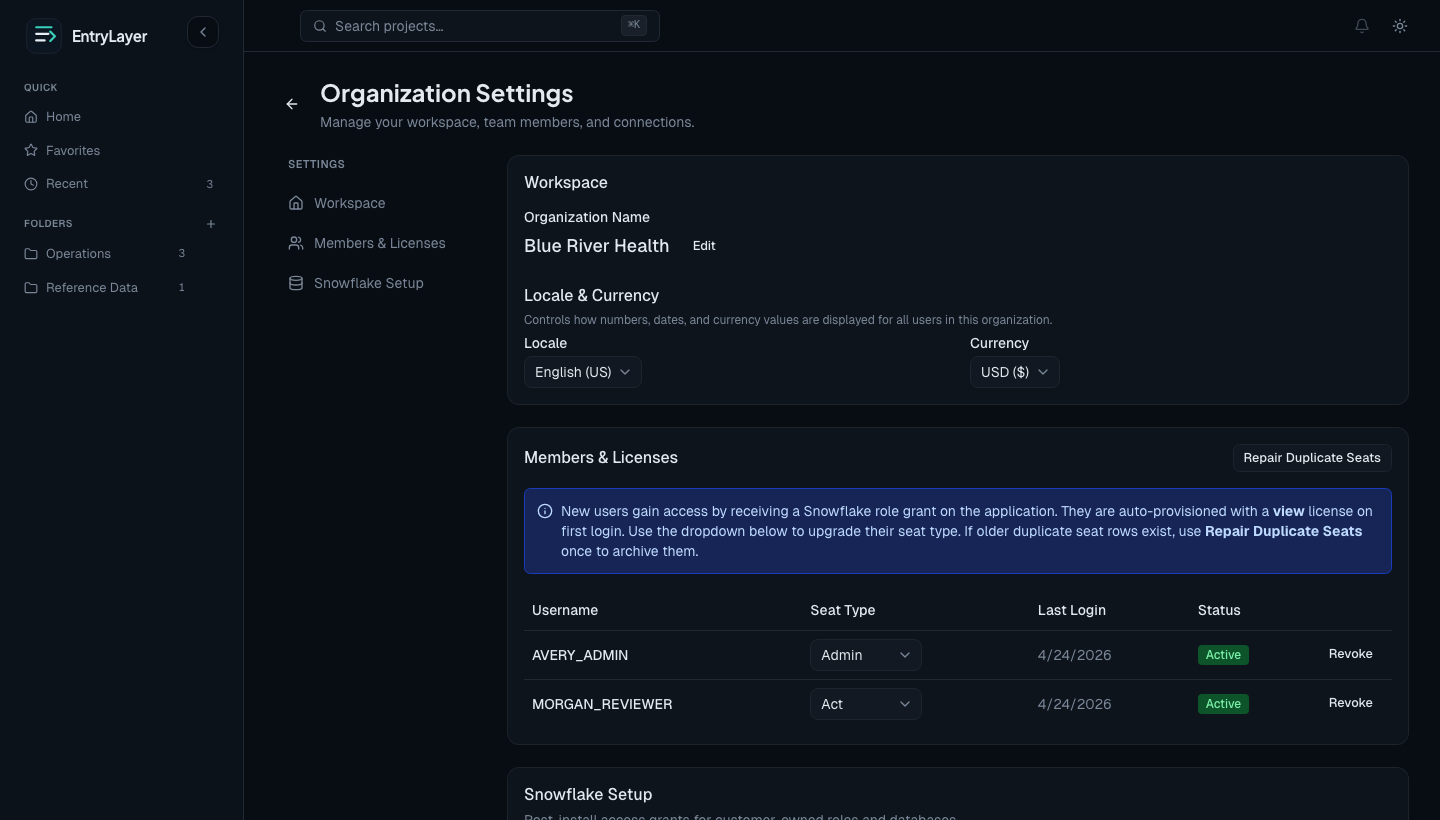
Workspace admins can see access diagnostics, member roles, and Snowflake setup guidance directly in the product.
Zero-access posture
EntryLayer's current trust posture is built around Snowflake-owned runtime, Snowflake-owned storage, optional event sharing, and limited billing events that do not need business payloads.
The Native App runs on Snowpark Container Services, with app state in Snowflake Hybrid Tables.
For supported consumer-owned data, source reads use the signed-in user context so Snowflake policies remain in force.
Normal product use does not require shipping customer records to vendor analytics or a hosted application database.
The product posture is designed so telemetry and billing do not become a side channel for business data.
Evaluation checklist
Admin visibility
The product includes guided Snowflake setup, member-role management, and live access diagnostics so teams do not have to treat operational security as a hidden backend concern. That makes rollout easier and makes support conversations more concrete.
Check session, warehouse, and source access directly from the admin UI.
Use in-product guidance and copyable SQL to complete Snowflake access setup.
Technical review
The documentation covers runtime architecture, permissions, virtual submissions, and the zero-egress posture so your security and platform teams can evaluate the product directly.